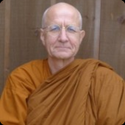
Ajahn (formerly Vitauts Akers), was born in Germany, 1947, to Latvian refugee parents. They moved to Toronto when he was four years old. Around 1969, while living in India, he encountered Buddhism, meeting the late Sāmanera Bodhesako, who introduced him to the teachings of the Buddha. He eventually travelled to Thailand to become a novice at Wat Mahathat in 1973 and took bhikkhu ordination the following year at Wat Pah Pong with Ajahn Chah. He was one of the first residents at Wat Pah Nanachat, the international monastery in north-east Thailand. Having spent four years in Thailand, he went back to Canada to visit his family in 1977. Instead of returning to Thailand, he was asked by Ajahn Chah to join Ajahn Sumedho at the Hampstead Vihāra in London. Later, he was involved in the establishment of both the Chithurst and Harnham monasteries in the UK. In 1985, invited by the Wellington Theravāda Buddhist Association, he moved to New Zealand, accompanied by Venerable Thanavaro, where he lived for 10 years, setting up Bodhinyānārāma monastery. In 1995 he came to the UK to assist Ajahn Sumedho at Amarāvati and stayed for four years before returning to New Zealand, where he lived until 2002. He was living in Ottawa caring for his mother for nine years and is now resident full time at Tisarana.
This talk was given as part of Vesak reflections, that celebrate the Buddha's birth and entry into pari-nibbanna. Luang Por reflects on the question: Was the Buddha humble?
Humble in this context refers to a mind, without a sense of "conceit", or I making and my making. Without "self narratives"
Freedom can't be something that is "fascinating", it has to be bigger than the dualistic polarity of the conditioned world. That is something beyond fascination and boredom. The modern consumerist world want to keep us fascinated, keep us "engaged", so we continue to consume. What happened when we step outside that constant stimulus. And boredom sets in?
Ajahn Viradhammo reflects on the "foreground" and "background" idea that he often speaks about. The background is the awareness, and the foreground is the objects that arise and cease in awareness. When those objects are unpleasant or pleasant to we become obsessed by them, and "become" them. Or can we stay as the background watching phenomena arise and cease?