|
|
Donate |
Contact
|
|
|
 |
|
|
|
|
|
The greatest gift is the
gift of the teachings
|
|
|
| |
|
Retreat Dharma Talks
|
|
Monday and Wednesday Talks

|
| Regular weekly talks given at the lower Spirit Rock meditation hall |
|
Spirit Rock Meditation Center
|
|
| |
|
2026-04-01
Talk on Donald's Four-Week March Retreat, Discussion, An Appearance by Guru Garbanzo Bean, and An Honoring of Cyndy Gagne
65:21
|
|
Donald Rothberg
|
|
|
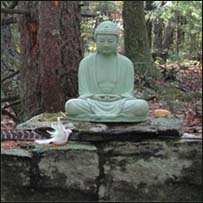
Donald explores some of the main themes of his March retreat, connecting these themes to general aspects of our practice. He shares some images of the Spirit Rock land, a group of turkeys, his place of practice and altar in his room, and the bench where he twice a day carried out a kind of ritual "talking to" his parents, who are deceased. He focuses on themes of listening for what calls one in one's practice and his main practices during the retreat: concentration practice, metta practice, the Tibetan practice of tummo (the inner fire) and the life of Milarepa, and awakened awareness. He concludes by speaking of some ways of keeping the retreat going in daily life, and, in preparation for the appearance of the Garbanzo Bean, Donald's clown personality, some on humor and spiritual practice. There is then discussion, including an appearance by Guru Garbanzo Bean responding to some questions, and closing in which we remember and honor Cyndy Gagne, a sangha member who recently passed.
|
Attached Files:
-
Guru Garbanzo Bean
by Donald Rothberg
(PDF)
|
|
2026-04-20
What Do We Rely On in a World Like This?
1:43:25
|
|
Gullu Singh
|
|
|
What do we rely on in a world like this? When everything feels marred by conflict and division, violence and chaos, the mind easily fixates on fear, confusion, loss of faith. But if we keep fixating, our lives begin to organize around those energies. Taking refuge is a way of interrupting that pattern. Refuge not as a belief statement, but more like a commitment or a resolve to keep moving to align with a particular orientation to life. That we choose, again and again. And this view shifts dependency from external conditions to awakening, to the truth, to the field of practice.
|
|
2026-05-06
Guided Meditation on Developing Concentration (Samadhi) 1
47:28
|
|
Donald Rothberg
|
|
|
Full instructions are given at the beginning for cultivating concentration (samadhi), including attention to posture, a variety of possible areas of focus (with most attention given to the breath, including on the "three-part breath"), and balancing "not too tight" and "not too loose." Then we practice mostly in silence, with a brief discussion period at the end of the sitting.
|
|
2026-05-06
Talk and Discussion: Developing Concentration (Samadhi) 1
60:54
|
|
Donald Rothberg
|
|
|
In this overview about developing concentration (samadhi) in our practice, we examine (1) the nature of concentration (or samadhi), including the etymology of the term and how we often find a natural concentration in daily life; (2) its importance in our practice; (3) some ways to practice to develop concentration, and (4) five challenges of such practice and how to work with them. The talk is followed by discussion.
|
|
2026-05-13
Guided Meditation on Developing Concentration (Samadhi) 2
44:31
|
|
Donald Rothberg
|
|
|
We review at the beginning the basic instructions for cultivating concentration (samadhi), including attention to posture, a variety of possible areas of focus (with most attention given to the breath, including the technique of practicing with the "three-part breath"), and balancing "not too tight" and "not too loose." We also review the main challenges that can arise in such practice, and how to work with these challenges. Then we practice mostly in silence, with a discussion period at the end of the sitting.
|
|
2026-05-13
Talk and Discussion: Developing Concentration (Samadhi) 2: Reviewing the Foundations and Pointing to How Our Practice of Developing Samadhi Deepens
59:09
|
|
Donald Rothberg
|
|
|
We begin with a review of the nature of samadhi and of samatha practice, in which we develop greater samadhi. Samadhi is understood as a natural quality (including with other species) that we may know through times in which we are deeply immersed and absorbed in an activity, such as being with another, art, music, or sports. Samatha is one of the two main forms of meditation taught by the Buddha, along with insight practice.
We also give an overview of how samatha practice deepens, going into some depth on the model of the five jhanic factors, and pointing to the experiences of the first two jhanas (as taught by the Buddha).
The talk is followed by discussion.
|
Attached Files:
-
The Five Jhanic Factors
by Donald Rothberg
(PDF)
|
|
2026-05-25
Memorial Day and Dharma Practice
65:27
|
|
Donald Rothberg
|
|
|
After some personal stories from Donald about his father, who was a veteran, and about Donald’s experiences growing up at the time of the Vietnam war and being introduced to nonviolence, we explore the three main dimensions of our practice (training in ethics, meditation, and wisdom) related to the holiday. We focus on the ethical teachings about killing and nonviolence, including the complexities of these teachings; the importance of bringing mindfulness to grief, loss, and sadness, and of grounding in kindness, compassion, and love; and the wisdom and insight teachings about seeing the roots of violence. The talk is followed by discussion.
|
|
|
|
|
|
|
|
|