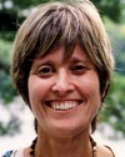
Madeline has loved the Dharma since 1986. She is Co-founder and a Teacher of South Shore Insight. Madeline teaches at Cambridge Insight Meditation Center and at Insight Meditation Society. Madeline teaches retreats for LGBTQ communities at Spirit Rock Meditation Center and Garrison Institute. She also worked at UMASS Medical Center for Mindfulness, Healthcare and Society teaching Mindfulness-Based Stress Reduction in MA prisons.
I find teaching to be a very deep and powerful "no self" practice. When I connect with others during Dharma talks--in the intimacy of small groups, and while holding meditation practice interviews--I am continually reminded to know, and be, in a place of clarity, spaciousness and immediate presence. Being able to offer students such a place of connection is my greatest pleasure and inspiration, as well as the most appreciated challenge in my teaching practice.
For me, the real fruit of the teaching is seeing the beauty of a gradual, and sometimes sudden, unfolding of a heartmind into its true self; seeing the variety of ways a person's essential, creative energy of being flows into the world.
On one end of the teaching, I am excited and inspired by students who are deeply committed to long-term, intensive practice. On the other end (and of course they're connected), I find that working closely with people at the grass roots level--in a co-creative process of developing and sustaining Dharma practice, study and community opportunitiies on a day-to-day basis--is equally exciting and inspiring.
From the immediacy of presence flows a wisdom that naturally connects us to the way of things. This amazing gift of mindfulness provides us with a spaciousness where we can make appropriate, healthy and creative life choices. Rather than being caught up in our old, conditioned habits, mindfulness provides us with the gift of engagement at its best. This is the Gift of the Dharma that we offer to all beings.
Marjolein Janssen (pronunciation “Mar-yo-line”) has been practicing insight meditation intensively in Europe, the US, as well as Myanmar, where she was ordained as a Buddhist nun. Marjolein brings practice in daily life, as well as formal practice to her teachings. She seeks to offer a practical approach to Buddhist concepts and ideas. Her sharing of the Dharma comes from her wish to contribute to the freedom and happiness of all beings. She practices and teaches meditation in the insight tradition, also called vipassana. Her teachers are the Burmese monk Sayadaw U Tejaniya, as well as the Western teachers Andrea Fella, Susie Harrington and Gil Fronsdal. Marjolein is a graduate of the Retreat Dharma Teacher Training with Gil Fronsdal and Andrea Fella, the Nature Retreat Teacher Training with Susie Harington, Gil Fronsdal and Mark Coleman, and the Hakomi Comprehensive Training. Additionally she is a certified Buddhist Eco-Chaplain through Sati Center. Marjolein is originally from the Netherlands. She now lives in Richmond, VA.
Mark Coleman has been engaged in meditation practice since 1981, primarily within the Insight meditation tradition. He has been teaching meditation retreats since 1997. His teaching is also influenced by his studies with Advaita Vedanta and Tibetan teachers in Asia and the West, and through his teacher training with Jack Kornfield. Mark primarily teaches at Spirit Rock Meditation Center in California, though he also teaches nationally, in Europe and India.
He leads backpacking retreats, nature-based retreats, and teaches retreats for environmental activists in the wilderness at Vallecitos Mountain Refuge in New Mexico, and at Knoll Farm in Vermont. In the Bay Area, Mark has a counseling practice, where he integrates his studies of psychotherapy and meditative work. He is the author of “Awake in the Wild - Mindfulness in Nature as a path of Self-Discovery." Mark has been an avid hiker, and backpacker for most of his life and spends much of his time in the outdoors. He lives in the woods in Marin County, Northern California.
Mark Nunberg began his Buddhist practice in 1982 and has been teaching meditation since 1990. He co-founded Common Ground Meditation Center in Minneapolis, MN in 1993 and continues to serve as the center’s guiding teacher.
Mark began practising meditation in 2008 and spent the following four years living and working in retreat centres and monasteries around the UK and Asia. Motivated to make these precious teachings more widely accessible and available, in 2013 he co-founded Freely Given Retreats and soon afterwards pioneered taking mindfulness courses into UK prisons. In more recent years Mark has been especially engaged with environmental and social justice issues. He was a close student of the late Rob Burbea.
Marvin G. Belzer, PhD, has taught mindfulness meditation for twenty years. He is an Adjunct Associate Professor in the UCLA Department of Psychiatry and Biobehavioral Sciences. For many years he taught a semester-long meditation course in the Department of Philosophy at Bowling Green St. University, where he was an Associate Professor of Philosophy. He teaches an undergraduate course at UCLA (Psychiatry 175: Mindfulness Practice and Theory) and teaches mindfulness in many different venues in Los Angeles.
Mary Aubry has been meditating and attending insight retreats for over 25 years. In 2009, she attended her first jhana retreat with Leigh Brasington, who authorized her to teach the jhanas in the tradition of the Venerable Ayya Khema. Other than Leigh, her primary teachers include Joseph Goldstein, Tara Brach, and Bhikkhu Analayo. She is a teacher with the Insight Meditation Community of Washington, D.C. and teaches retreats nationally on insight, the jhanas, and the brahma viharas.
Lately, my own practice is moving more and more into the monastic world. As I teach out of that nourishment, I find people hungry for the traditional, solid forms of the Dharma. I see people's lives changing when they engage in these forms. Certainly, as I deepen my own Sutta study, I find the traditional ideas so helpful it encourages me to delve further.
In this, I am learning how to ride the edge of a question, instead of reaching for answers. When I let the question hang there, as a living presence, its very aliveness stimulates movement toward an answer, an opening.
Some key factors imprint my teaching. The fact that I'm a purely Western-produced Dharma teacher, without the influence of Eastern traveling, and that I'm a middle-aged Western woman with a psychological background. Also, my years in a Christian practice now translate into my engagement with such ideas as embodiment: how do we take the practice and live it? What is practical in the Dharma, a sort of Buddhist Householder Hints.
From my perspective, the world is in serious trouble. We have separated ourselves from all other beings, and in the process do a lot that keeps us from being present. It is so urgent that we learn to be present and see what is true about our being here, that we live with kindness and compassion for all beings. Vipassana supports these intentions and helps us all heal, no matter what the eventual outcome may be.
Matthew Brensilver, MSW, PhD, serves on the Guiding Teachers Committee and Board of Directors at Spirit Rock Meditation Center. He was previously Program Director for Mindful Schools and for more than a decade, was a core teacher at Against the Stream Buddhist Meditation Society. Each summer, he lectures at UCLA’s Mindful Awareness Research Center on the intersections between mindfulness, science and mental health. Before committing to teach meditation full-time, he spent years doing research on addiction pharmacotherapy at the UCLA Center for Behavioral and Addiction Medicine. He is the co-author of two books about meditation during adolescence.
Matthew Daniell began Buddhist meditation in Asia in 1985. He practiced Zen in Japan, Tibetan Buddhism in India, and Insight Meditation in the United States, India, Burma, and Thailand, where he was an ordained monk for more than a year. His Asian teachers include Harada Roshi, Kalu Rinpoche, Dipama and Munindra. His Western teachers include Larry Rosenberg, Jack Kornfield, Joseph Goldstein, and Sharon Salzberg. Matthew is a founder and the guiding teacher at the Insight Meditation Center of Newburyport, Massachusetts (IMCNewburyport.org), and is a member of the Religious Services Department at Phillips Exeter Academy.
Matthew Hepburn caught fire with the Dharma through retreat practice in his early twenties. He began offering vipassana instruction in 2012 at the Cambridge Insight Meditation Center, where he is continually inspired by the deep Dharma of daily living. He is a participant in the 2017-2021 IMS Teacher Training Program.
Mei Elliott is a Dharma teacher in the Theravada Buddhist tradition, who practices at the intersection between Zen and Vipassana. Mei began training as a Zen monk at Tassajara Zen Mountain Center in 2014, and has spent eight years living at Zen temples and monasteries. During this time she served as the director of San Francisco Zen Center and the guiding instructor for Young Urban Zen. Mei was authorized to teach by James Baraz and is a graduate of Insight Meditation Center’s Dharma Teacher Training. She now resides at Insight Retreat Center where she serves as Managing Director.
Melanie Waschke has had a Meditation practice since her early twenties. She has been deeply involved in the mindfulness practice taught by Thich Nhath Hanh, living in his retreat centers for over a year as well as doing a lot of long term practice in the Vipassana tradition worldwide. Currently she is part of the teacher training program led by Jack Kornfield, Joseph Goldstein and others. Melanie Waschke is a clinical psychologist, working in Germany. She teaches meditation in English and German.
I find that practitioners can practice Vipassana for a long time without paying attention to the role that fear plays in their lives. Living with fear that is unacknowledged leads to fragmentation in life and practice. I encourage people to look at the energy of fear, for fear can limit our access to freedom.
It is quite possible to diligently practice mindfulness, yet keep fear at a distance. Not becoming intimate with fear creates a dualism and complacency that gives a silent nod of approval to living with fear. When we begin to look at, and become friends with, our fear, we suddenly discover a lot more space in our lives.
In the larger picture, Vipassana offers us all a practice that goes counter to the tremendous cultural momentum around us of materialism and consumerism. With practice, we can learn how to take full responsibility for ourselves, and so pay attention to developing inner qualities capable of sustaining us as we navigate the shifting sands of life.
For over 35 years Michele has been a pioneer in bringing together Zen and Vipassana, Deep Ecology, Social Justice, Non-Violence, Leadership Training, and Personal and Business Development modalities, before such integration was considered possible. She works extensively to create diverse environments and champion high-risk communities. Michele is a high ranking woman Sensei (teacher) in Aikido and Iaido sword, a visual artist, Hypnotist, NLP Transformational Mentor and Coach, and co-founder of Manzanita Village Center in Warner Springs, CA and Five Changes.
Because I've been teaching in Burma the last three years, I've been able to see how mindfulness can be nourished by a culture that supports the ancient liberation teachings and by daily experiences of happiness arising from acts of generosity, morality and renunciation. Thus the practice of Buddhism and the living of Buddhism are woven together in a seamless tapestry.
If there is anything that is most engaging to me now, it is the desire to bring this sublime way of life into our culture in the West.
What began as a deep compassion for the suffering of the existential predicament of human beings deepened as I understood that we need not identify with our experience. It is this understanding that has led me far onto the path of befriending others on their spiritual journey. My greatest inspiration is working with students wherever they are in the moment. We are all capable of so much more than suffering; once we learn how to be mindful, it's only a matter of remembering that it is the purity of intention which frees us. Dismantling the myth that we need to be something other than what we are is so important, because if we can learn to be mindful of exactly where we are, we experience the happiness of peace, which is what we deeply are.
My deepest appreciation is for the joy of the spiritual adventure. The purity of mindfulness, which soothes our sophisticated, intellectual, analytical, and out-of-touch-with-our-bodies mindset, is the moment we remember to pay attention without embellishment, interpretation or judgment. That moment becomes overwhelmingly touching because it brings us what we most wish for, unconditional love and peace. This truth, this purity of intention is what brings us home.
Molly is a co-founder of True North Insight and a former guiding teacher of TNI. She has been engaging in spiritual inquiry and dharma practice since 1985, both in Asia and the West. She has been teaching Insight Meditation retreats primarily in Canada since 1997 and offers classes, retreat days & individual support closer to their home in Guelph, Ontario.