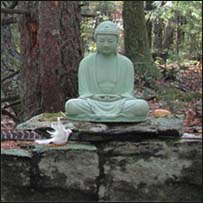
Bringing a way of looking that sees all phenomena as not peaceful, all modes that hold them in attention as not freeing, to engender a deeper letting in, be, go. This guidance has a live translation into Czech.
Balance between discipline and self-love; failure as a shadow side of practice; addiction to Dhamma talks/books; skillful way to deal with anger; benefits of regulating breath.
Use of images and recollections to deeply experience the qualities of the brahmaviharā. Keep attention wide, body relaxed, attuned to how things are felt – shifting, moving, and affecting the body. And is it possible to turn any feature of these intentions towards yourself?
The way to make use of the closure of retreat is to harvest. Standing at the door of the mind, use the body for support to review the stuff of the mind from a balanced place. The upright axis cools the field of reactivity. Witnessing with disengagement, don’t be deceived by what appears internal and external, it’s all happening in the mind.
Guidance to gradually return to awareness through the sense fields. No pushing, just expanding lightly, integrating the inner domain with your external circumstance in whatever you do next.
The occasion of puja provides a useful link between our inner realities and outer circumstances. As we chant and make offerings, we’re open and receptive to the virtue, values, insights of our depth experience. The body picks up these signs as deep tissue memories, making these qualities available to enrich what we do in the external world.
The principles of mindful leadership are relevant for all of us—they bring out the best of who we are in our work, with our family, with our friends. Especially in these times of mistrust and dividedness, our world desperately needs each of us to cultivate the qualities of focus, presence, care, respect, clarity, and curiosity that mark a true leader. Michelle Maldonado is a brilliant teacher of mindful leadership, and she embodies the compassion and skillfulness she invites forward in others.
What is happiness? We think that when things are going well, happiness is here and everything will be fine. When conditions are unpleasant, we feel we have failed. But the universe is creative in its unfolding, and happiness can come in different ways than we expect.
Bringing dukkha (unreliable/unsatisfactory) as a way of looking brings freedom from dukkha. This talk has a live translation into Czech that is not recorded, yet it might seem slow as Nathan waits for the translation to complete before offering the next sentence.
Taking care with what we connect with, with that which supports our capacity to be here – grounded, present, receptive. Guard from anything that takes us away from the fullness of citta. In this place we keep meeting whatever is arising with qualities of friendliness and welcome, everything belongs. From that place of welcome, response happens. Love meets love.
If we come back to the primary frame of this teaching, the work is to understand how this heart gets agitated, to see how suffering arises. If we are upright, if we have this sense of goodness and connectedness, there’s a capacity to meet the difficulties rather than struggle with it. Grounded in this strength, remain available to what’s happening here.
An anicca way of looking. This guidance has a live translation into Czech that is not recorded, yet it might seem slow as Nathan waits for the translation to complete before offering the next sentence.
Advice for specific sāti helpful in each posture. Establishing ground, steadiness and center while keeping awareness wide, allow dhammas to swim by, letting them all go. A certain strengthening effect comes from that.
Difference between wise caution and anxious reaction; use of psychiatric medicines; please condense teachings and instructions for practice; cultivating relationship with gods/celestial beings; commitment to waking up entangled with wanting and striving; transitions in place, experience and practice.
Realization isn’t something you do, it’s something that arises from beyond yourself. When we stop reacting to the stirrings of our kammic field, stop creating a self, awareness can lift and witness – this is suffering, this is its origin, this is how it ceases. As we begin to wear out these distorted psychologies that make up the self, qualities of happiness, freedom, joy and love become available as a gift.
The nature of puja is it’s a direct participation in Dhamma. Setting aside what is not needed, boundaries of self and circumstance dissolve and there’s just the upright center, receptive. Surveying the field of kamma from this awakened position gives you a direction, a vantage point from which to navigate your day and your meditation.
Accepting my own aging; emptiness; is taking a stance alignment rather than saṇkhāra; how to deal with conflict mindfully; can our practice become self-centered; how to maintain this in daily life; how to repay kamma/transfer merit for accidentally killing animals; struggling to wake up and meditate; how to work with desire for solitude and concern over isolation/loneliness; how to relate to mother who has long term issue of complaining.
Practicing in the upright body, surveying the field, whatever is happening for you, wherever you are, however you are – it’s like this now. Without reacting, denying, fighting or fudging, staying with experience but not in it. That’s the still point. Through that power of this truth, the tide of kamma begins to settle and clarify, and wisdom begins to arise.